
Constipated? The wrong fibre could be making it worse.

There’s often some confusion about whether adding more fibre to the diet will help ease constipation, especially if that fibre is making you more bloated. There are certain types of fibre that are helpful and other types can make things worse – but it often depends on what the issue is.
For longstanding, chronic constipation, where things are generally moving slowly through the gut, increasing fibre overall will usually not be enough and can often make things worse, especially if you are putting lots of gassy vegetables into an already unbalanced system.
There are certain types of fibre that have been recommended by the British Dietetic Association as being effective for chronic constipation and are good ‘all rounders’.
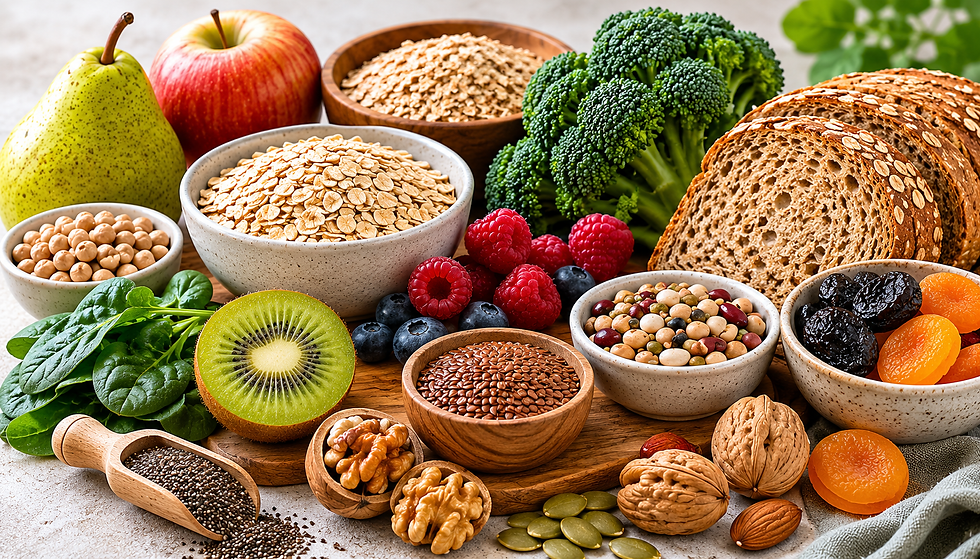
This includes Kiwi fruits and psyllium fibre (usually bought in a powder or capsule form, can be added to bread). These contain mainly soluble fibre which means it dissolves in water to form a gel to help move things along. Linseeds & Chia seeds are also a soluble fibre and whilst these weren’t shown in the BDA study to have significant effects, many practitioners use flax & chia successfully for most types of constipation – either added to a smoothie, porridge or into bread.
A caution with psyllium is that it’s not always helpful when the constipation is caused by slow movement of matter through the gut (slow transit time).
Hydration is really key here, whenever fibre is added, it’s really important to increase water intake, otherwise things can dry up and worsen the issue.
Then there is the resistant starch category of fibre which includes potatoes and rice ( in particular cooked & cooled, next day leftovers). These types of fibre provide bulk to the stool as they resist digestion and in a healthy gut they can be really helpful.
However there are some instances where this type of fibre may make things worse. For example, quite a few people with constipation have a lot of methane being produced in the colon by organisms called methanogens. High methane levels slow down the passing of food through the gut, it also increases bloating and constipation. These methane producing organisms feed on resistant starch. So where resistant starch can be helpful when there is low methane, for high methane people, it will make things worse.
This is where it really helps to do a test to find out whether there is high methane in the gut or not. If there is high methane then there are protocols that can be followed with the guidance of a practitioner that can help re-establish balance and reduce the methane production, this can then solve the constipation and IBS symptoms. The protocols will include specific forms of fibre but be low in resistant starch and may include other personalised supplements.
The other main source of fibre comes from vegetables like courgettes, carrots, pak choi, spinach, green beans, peppers, celery, radish, watercress. These specific vegetables (also called Low FODMAP vegetables) are less fermentative and more digestible than resistant starch, they have both soluble and insoluble fibre and gently stimulate the bowel without triggering bloating & gas. These type of vegetables can be helpful in a reactive gut.
Then there are the more fermentable, gassy vegetables: onion, garlic, cauliflower & cabbage and also fermented foods like sauerkraut. These are great for healthy guts but for those with constipation associated IBS, these vegetables can increase gas production & potentially increase methane production. Whilst these foods are healthy and should not be excluded long term, caution should be used with them and kept low in the diet where there is a lot of bloating (these foods should not be excluded for longer than 6 weeks).
Overall, it’s recommended that we aim for 30g fibre per day. An example of how to reach that and support good bowel movements would be to include a smoothie with 2 x kiwi, berries, chia & flax; 1-2 slices of rye bread or wheat sourdough (or buckwheat sourdough if gluten free), and some vegetables with lunch and dinner.
If you are interested to know more about this topic or want to test for methane production. You can book a free consultation via my website.


Comments